Using an old software version can create security, compatibility, and performance problems that become harder to fix over time. If you are asking why updating immorpos35.3 software is important, the first step is to verify that the update comes from a trusted source and matches the software you actually use. Public information about Immorpos35.3 is limited and inconsistent, so users should avoid relying on unsupported feature claims. Standard software-update guidance still provides a clear reason to keep legitimate applications maintained: updates can correct security and functionality problems and add improvements.
What Is Immorpos35.3 Software?
Immorpos35.3 is an unfamiliar software name with limited publicly verified documentation. Different websites describe it in different ways, including business software, workflow tools, technical utilities, and other types of applications.
Because these descriptions conflict, you should not assume that every feature mentioned online belongs to the same product. Before installing or updating anything, confirm the application’s developer, official download location, version number, and release information.
The 35.3 portion may represent a version or build identifier, but its exact meaning cannot be confirmed without reliable product documentation. Treat the version label as unverified until the software’s legitimate source confirms it.
Why Updating Immorpos35.3 Software Is Important
The main reason why updating immorpos35.3 software is important is simple: software maintenance helps address known problems and keeps a system closer to its supported state.
NIST describes patch management as the process of identifying, prioritizing, acquiring, installing, and verifying software patches and updates. It notes that patches can correct security and functionality problems while also adding new capabilities.
For any legitimate application, delaying important updates can leave known weaknesses unresolved. CISA similarly advises users not to delay software updates because software flaws can provide attackers with opportunities to access files or accounts.
Quick Benefits of Software Updates
| Benefit | What an Update Can Do | Why It Matters |
| Security | Address known vulnerabilities | Reduces exposure to known software flaws |
| Stability | Correct software defects | Helps reduce crashes and unexpected behavior |
| Compatibility | Improve support for newer systems | Helps software work with changing environments |
| Functionality | Add or improve capabilities | Gives users a more current release |
| Maintenance | Keep software supported | Makes long-term management easier |
| Reliability | Resolve known problems | Can improve day-to-day use |
| Performance | Fix inefficient behavior | May make specific tasks work better |
| Risk control | Reduce known weaknesses | Supports safer software management |
These benefits describe software updates generally. They should not be interpreted as confirmed features of a specific Immorpos35.3 release unless the software’s legitimate developer documents them.
Security Is a Major Reason to Update
Security is one of the strongest reasons to keep legitimate software patched.
Developers may discover vulnerabilities after releasing an application. A later patch can address those weaknesses and reduce the period during which an affected version remains exposed.
NIST states that applying patches to remove software vulnerabilities can significantly reduce opportunities for exploitation. Its guidance also treats patching as preventive maintenance rather than an optional activity.
This does not mean every update automatically makes software completely secure. Good security also requires safe passwords, access controls, backups, trusted downloads, and other protective measures.
Updates Can Fix Software Problems
Another reason why updating immorpos35.3 software is important is bug correction.
Software can contain defects that only appear under certain conditions. A developer may later release a patch that fixes crashes, incorrect behavior, failed processes, or other technical problems.
However, do not assume that an alleged Immorpos35.3 update fixes a particular bug unless the release notes or official documentation confirm it.
Common Problems an Update May Address
An application update may correct:
- Unexpected crashes
- Installation problems
- Compatibility errors
- Incorrect calculations
- Interface bugs
- File-handling problems
- Connection failures
- Known security weaknesses
- Conflicts with newer operating systems
- Other documented software defects
The exact changes depend on the application and its developer.
Better Compatibility With Other Software
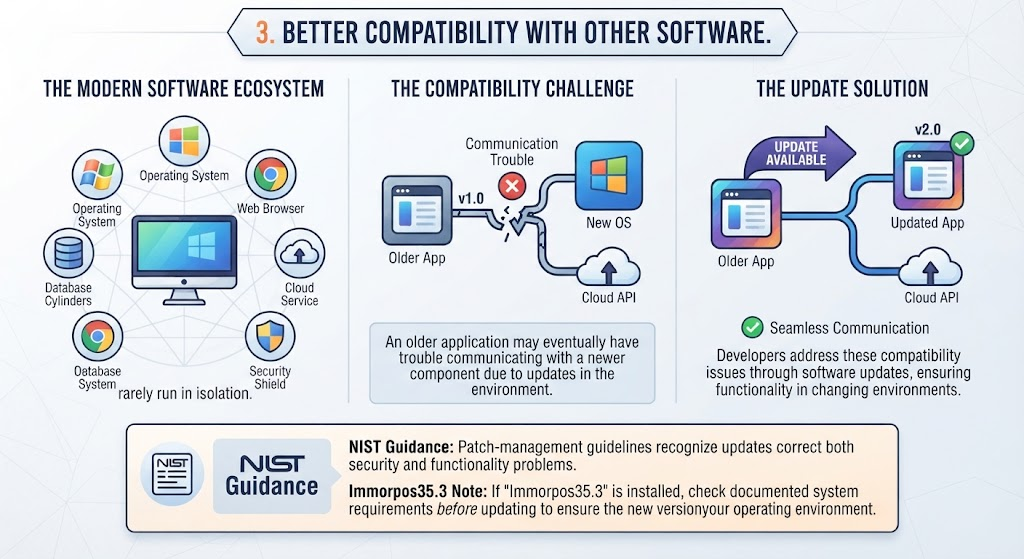
Modern computers rarely run one application in isolation. Operating systems, browsers, drivers, databases, cloud services, libraries, and security tools change over time.
An older application may eventually have trouble communicating with a newer component. Developers can address these compatibility issues through software updates.
NIST’s patch-management guidance recognizes that updates can correct both security and functionality problems.
If Immorpos35.3 is installed on your computer, check its documented system requirements before updating. This can help prevent installing a version that does not match your operating environment.
Updates Can Improve Reliability
Reliability matters when software handles important work.
Repeated crashes, failed processes, corrupted settings, or unexpected errors can waste time. A legitimate maintenance release may address problems discovered after an earlier version reached users.
This is another practical answer to why updating immorpos35.3 software is important: keeping software maintained can reduce the burden of known technical issues.
Still, an update should not be treated as a guarantee that every problem will disappear. Test important workflows after installation, especially when the application supports business or operational tasks.
New Features May Improve the User Experience
Software updates can also introduce new functions or improve existing ones.
NIST notes that patches can do more than correct vulnerabilities; they can also add new features and security capabilities.
For Immorpos35.3 specifically, do not trust online articles that list new features unless those features appear in documentation from the actual developer. Public descriptions of the product are too inconsistent to establish a reliable feature list.
Updating Can Reduce Long-Term Technical Risk
Running old software creates a maintenance problem because multiple versions can become difficult to track.
A structured update process gives users a clearer way to identify installed versions, review available patches, test changes, and verify successful installation. NIST recommends treating patching as an organized process rather than an occasional reaction to problems.
For an individual user, that can be as simple as:
- Check the current version.
- Identify the legitimate developer.
- Find the official update source.
- Read the release notes.
- Back up important data.
- Install the update.
- Restart if required.
- Test the software.
- Confirm the new version.
Why You Should Verify an Immorpos35.3 Update First
Knowing why updating immorpos35.3 software is important does not mean you should download the first update you find online.
This is especially important because publicly available information about the name is inconsistent. An unofficial website could use a familiar software name to distribute an unrelated installer.
Check These Details Before Downloading
| Check | What to Look For |
| Developer | A clearly identified software publisher |
| Website | A legitimate official domain |
| Version | The installed and offered versions should match |
| Release notes | Clear information about changes |
| File source | Download should come from a trusted source |
| Digital signature | Verify it when available |
| Support | Genuine documentation or support information |
| Reviews | Use them as supporting evidence, not proof |
| Antivirus scan | Scan downloaded files before opening |
| Backup | Protect important data before major updates |
If you cannot identify who actually publishes the software, do not install an unknown executable simply because a webpage calls it an “official update.”
Should You Update Immediately?
Not every update should be installed without checking it first.
NIST’s 2025 guidance highlights an important balance: organizations need to deploy patches quickly when vulnerabilities are serious, but they also need to test updates so that changes do not disrupt important functions.
For ordinary users, a practical approach is:
- Security-critical update: prioritize it after verifying authenticity.
- Routine bug-fix update: review the release notes first.
- Major version upgrade: check compatibility and backups.
- Unknown update: verify the publisher before installation.
- Unverified third-party download: avoid it.
This approach combines security with caution.
How to Update Immorpos35.3 Safely
If you have a legitimate installation of Immorpos35.3, use this basic process.
Step 1: Check Your Current Version
Open the application’s About, Settings, Help, or System Information section. Record the exact version number.
Step 2: Identify the Publisher
Find the developer or organization responsible for the software. Do not rely only on the name of a download website.
Step 3: Find the Official Update
Use the publisher’s official website, built-in update system, or trusted software-management system.
Step 4: Read the Release Notes
Look for information about security patches, bug fixes, compatibility changes, requirements, and known issues.
Step 5: Back Up Important Data
If the application stores important files or settings, create a current backup before making a major change.
Step 6: Install the Update
Follow the developer’s installation instructions. Avoid disabling security protections simply to make an unknown installer run.
Step 7: Test the Application
Open the software and test the functions you use most often.
Step 8: Confirm the New Version
Check the About or version screen again to verify that the update completed successfully.
NIST recommends identifying, acquiring, installing, and verifying updates as part of an organized patch-management process.
10. What Happens If You Keep Using an Old Version?
There is no single outcome for every application. An old version may continue working normally for a while, but it can gradually become harder to maintain.
Potential problems include:
- Unpatched security vulnerabilities
- Compatibility problems
- Missing bug fixes
- Unsupported operating systems
- Older dependencies
- Reduced vendor support
- Difficulty migrating later
- Greater troubleshooting effort
This explains why updating immorpos35.3 software is important without claiming that every old installation will experience these problems.
The actual risk depends on the software, its purpose, its exposure to the internet, the type of data it handles, and whether the developer still supports that version.
How to Know Whether an Update Is Genuine
A genuine update should have verifiable information behind it.
Look for:
- A recognizable publisher
- A trusted download location
- A consistent version number
- Official release documentation
- Installation instructions
- A privacy or security policy where appropriate
- Contact or support information
- A valid digital signature when available
Be cautious if a webpage:
- Pressures you to download immediately
- Claims the software is “secret” or “exclusive”
- Provides no developer identity
- Uses several different product descriptions
- Offers an unexplained executable file
- Claims guaranteed security or performance
- Cannot provide credible release notes
A polished webpage does not prove that a software product or update is legitimate.
What Does NIST Say About Software Updates?
NIST provides one of the clearest explanations of modern patch management.
Its guidance defines patch management as identifying, prioritizing, acquiring, installing, and verifying patches, updates, and upgrades. NIST also states that preventive patching can help reduce compromises, data breaches, operational disruptions, and other adverse events.
In 2025, NIST also emphasized that software updates can address bugs and vulnerabilities while warning that poorly managed updates can introduce operational or security risks.
That means a good update strategy is not simply “install everything immediately.” It is “verify, prioritize, test when appropriate, install, and confirm.”
A Simple Update Checklist
Use this checklist whenever you receive an Immorpos35.3 update notification:
- Check the current version.
- Confirm the publisher.
- Visit the legitimate update source.
- Check the release date.
- Read the release notes.
- Check system requirements.
- Back up important information.
- Scan downloaded files when appropriate.
- Install the update.
- Restart the application or computer if required.
- Test important functions.
- Confirm the installed version.
- Keep the installer and documentation only if they come from a trusted source.
This simple routine can make software maintenance safer and easier.
Who Should Be Extra Careful With Updates?
Some users should take additional precautions before changing software.
Businesses
Businesses should consider whether the application connects to customer data, financial systems, databases, or other important services.
Developers
Developers should test updates in a development or staging environment before changing production systems when practical.
System Administrators
Administrators should maintain an inventory of installed software and prioritize important patches.
Home Users
Home users should focus on trusted update sources, backups, antivirus protection, and avoiding suspicious downloads.
NIST specifically recommends structured patch management because organizations must balance security needs with operational availability.
Frequently Asked Questions
Public information does not currently provide enough reliable evidence to confirm a single, clearly documented commercial product under this exact name. Online descriptions conflict, so users should verify the developer and official documentation before downloading or updating it.
Updating legitimate software can help address security vulnerabilities, functionality problems, compatibility issues, and other documented defects. NIST identifies patching as an important part of preventive technology maintenance.
Yes. Software patches can address known vulnerabilities. CISA advises users not to delay software updates because unpatched flaws can create opportunities for unauthorized access.
No. Use a verified publisher or trusted software-management source. If you cannot establish who developed the software or where the update originated, downloading an executable carries unnecessary risk.
For important software, backing up important data before a major update is a sensible precaution. It gives you a recovery option if an unexpected installation problem affects files or settings.
Do not repeatedly install random versions from different websites. Check the application’s official documentation, confirm system requirements, review the release notes, and use a verified support channel if one exists.
Conclusion
The key answer to why updating immorpos35.3 software is important is that software maintenance can reduce known security and functionality problems while helping an application remain compatible and manageable. However, updating only makes sense when you know what software you have, who publishes it, and where the legitimate update comes from.
For Immorpos35.3, that verification step matters because publicly available descriptions are inconsistent. Do not invent missing product details or trust an unverified download simply because a webpage calls it an official release.
Before updating, verify the publisher, check the version, read the release information, back up important data, and test the software afterward. That approach follows established patch-management principles from organizations such as NIST and CISA while keeping the focus on safe, practical software maintenance.