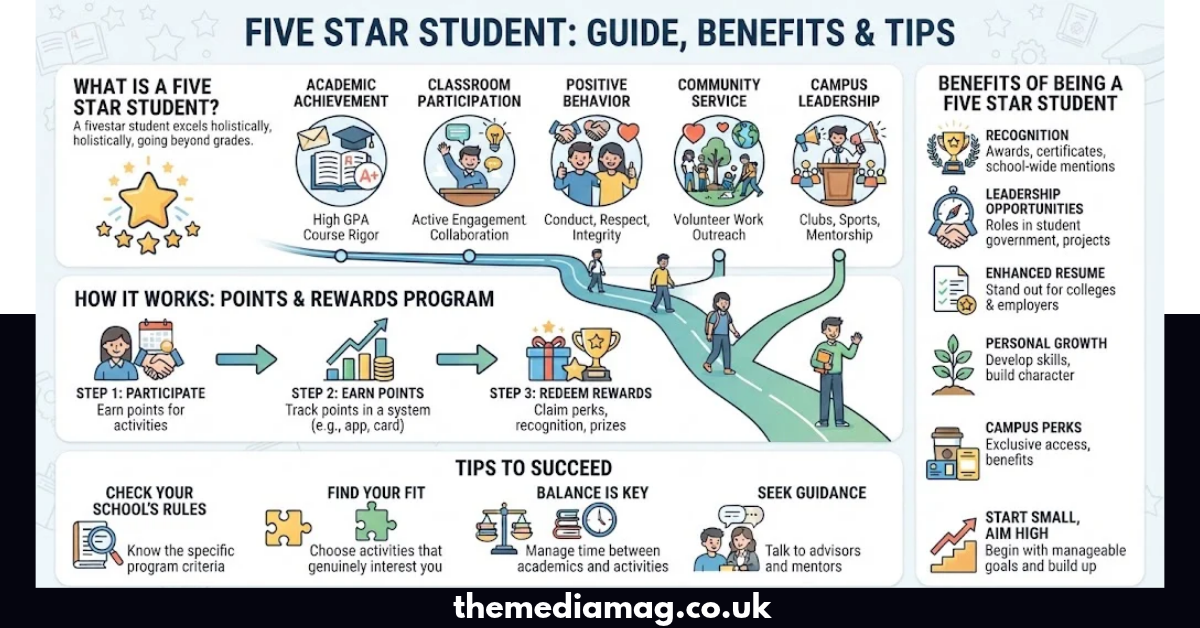
A fivestar student is generally a student who shows strong performance in several areas, not only classroom grades. Depending on the school or university, the term can describe academic achievement, participation, positive behavior, professional skills, community service, or involvement in campus life. Some programs use five areas or “stars” to assess students, while others use points and rewards for activities and positive conduct.
The exact meaning depends on the institution running the program. That is why students should check their own school’s rules before assuming that a particular grade, activity, or reward automatically qualifies them.
Five Star Student Meaning Explained
The simplest fivestar student meaning is a well-rounded student who performs well and contributes positively to the school or university community.
A strong student may have good grades, but a five-star model can look beyond marks. For example, the University of Blida 1 describes five areas that include academic performance, institutional experience, complementary skills, distance learning or academic mobility, and social commitment.
Common areas include:
- Academic performance
- Practical or professional experience
- Communication and digital skills
- Extracurricular activities
- Community involvement
- Positive behavior
- Attendance and participation
- Leadership
- Volunteer work
These areas can help students build a stronger educational profile instead of focusing only on examination results.
How Does the Five Star Student Program Work?
There is no single worldwide fivestar student system. Different institutions create their own criteria, scoring methods, applications, and awards.
For example, the University of Blida 1 evaluates students through five broad stages. The program looks at academic results, practical links with institutions, complementary skills, learning or mobility opportunities, and social integration.
Other schools use a different approach. A Fresno Unified school handbook describes Five Star Student as a system where students can earn points through school activities, positive behavior, and extra effort.
| Area | What It Can Include | Why It Matters |
| Academic performance | Grades, projects, classwork | Shows learning and achievement |
| School participation | Events, clubs, activities | Shows engagement |
| Positive behavior | Respect, responsibility, effort | Builds a healthy school environment |
| Professional skills | Digital tools, languages, practical work | Supports future career development |
| Community service | Volunteering and charity work | Shows social responsibility |
| Leadership | Student groups and representation | Develops communication and teamwork |
| Online learning | Courses and academic platforms | Expands knowledge and skills |
| Mobility | Exchange or study opportunities | Provides broader academic experience |
What Are the Five Stars?
In programs that specifically use five evaluation categories, each star can represent a different part of student development.
At the University of Blida 1, the five areas are clearly defined as academic performance, closeness with institutions, complementary skills, distance learning and academic mobility, and commitment and social integration.
⭐ Star 1: Academic Performance
The first area focuses on academic results. Grades, academic ranking, and demonstrated learning can play an important role.
A student does not necessarily need to excel in every subject equally. Consistent effort, strong results, and steady academic progress can all contribute to a strong student record.
⭐ Star 2: Practical Experience
The second area can connect classroom learning with real-world experience.
This may include field studies, practical projects, internships, or work with institutions. These experiences help students understand how academic knowledge applies outside the classroom.
⭐ Star 3: Additional Skills
A fivestar student may also develop skills beyond the main academic curriculum.
Examples can include:
- Foreign languages
- Computer and information skills
- Communication
- Organization
- Management
- Sports
- Cultural activities
- Scientific events
- Public speaking
These skills can become useful for university applications, internships, and future employment.
⭐ Star 4: Online Learning and Mobility
Modern education can happen both inside and outside the classroom.
Some Five Star Student programs recognize online learning, additional courses, or academic mobility. At Blida 1, this category includes online courses and academic mobility programs such as Erasmus-related opportunities.
⭐ Star 5: Social Commitment
The final area focuses on participation in the wider community.
Students may demonstrate this through:
- Volunteer activities
- Charity work
- Student representation
- Community projects
- Cooperation with recognized organizations
- Participation in university life
This area recognizes that education can involve responsibility toward other people as well as personal achievement.
What Are the Benefits of Being a Five Star Student?
The benefits depend on the institution’s specific program.
A fivestar student program can encourage students to develop a broader range of abilities instead of concentrating only on exams. It can also give students a clear reason to participate in clubs, volunteer work, practical activities, and additional learning.
Possible benefits include:
- Recognition from a school or university
- Certificates or awards
- Student rewards
- Greater campus participation
- Stronger extracurricular records
- More practical experience
- Better communication skills
- More opportunities to demonstrate leadership
Some programs provide formal awards. For example, the Bergen County Clerk’s official Five Star Student Award recognizes eligible high-school students for achievements such as volunteering, entrepreneurship, and overcoming adversity.
Who Can Become a Five Star Student?
Eligibility depends entirely on the program.
Some programs target university students in particular years. For example, a 2026 announcement from the University of Msila invited third-year undergraduate and second-year master’s students to apply for its Five-Star Student competition.
Other programs are designed for high-school students or school-wide participation.
Before applying, students should check:
- Eligible grade or academic year
- Enrollment requirements
- Application dates
- Required documents
- Academic requirements
- Activity requirements
- Recommendation requirements
- Assessment categories
- Award or certificate rules
What Are the Requirements for a Five Star Student?
There is no universal requirement list. Each institution can create its own criteria.
Common requirements may include academic performance, participation, positive behavior, extracurricular involvement, community service, or evidence of personal development.
For example, the University of Msila’s 2026 announcement established an application period specifically for eligible third-year license and second-year master’s students.
A typical application may ask for:
- Student identification details
- Academic information
- Activity records
- Certificates
- Volunteer evidence
- Recommendation letters
- Project information
- Supporting documents
Students should use official institutional instructions rather than relying on social-media posts or unofficial explanations.
How Can You Become a Five Star Student?
Becoming a fivestar student does not have to mean doing everything at once.
Start by building strong habits in the areas your institution actually evaluates.
1. Take academics seriously
Attend classes, complete assignments on time, and review difficult topics regularly.
Good academic performance often forms the foundation of student recognition programs.
2. Join useful activities
Choose activities that match your interests and academic goals.
A science student might join a research or technology group, while another student might prefer sports, cultural activities, debate, or volunteering.
3. Build practical skills
Learn skills that support your studies and future career.
Useful options include:
- Microsoft Office or similar productivity tools
- Research skills
- Presentation skills
- Public speaking
- Foreign languages
- Basic digital skills
- Project organization
4. Help your community
Volunteer work can demonstrate responsibility and teamwork.
Keep records of meaningful activities, especially when the program requires evidence.
5. Keep evidence of achievements
Do not wait until application day to search for old certificates.
Create a simple folder containing:
- Certificates
- Awards
- Volunteer records
- Event participation
- Course completion records
- Projects
- Recommendations
This makes applications much easier.
Five Star Student vs. Regular Academic Excellence
These terms are not always the same.
Academic excellence usually focuses heavily on grades or academic results. A fivestar student model can be broader and may consider activities, skills, participation, practical experience, and social responsibility.
| Feature | Academic Excellence | Five Star Student Model |
| Grades | Major factor | Often important |
| Activities | May have limited weight | Often included |
| Skills | Sometimes considered | Commonly included |
| Community service | May not be required | May be important |
| Leadership | Program dependent | Often encouraged |
| Practical experience | Program dependent | Can be included |
| Online learning | Usually separate | May be recognized |
| Social participation | Not always assessed | Can be a core category |
The important point is that the phrase fivestar student does not automatically mean “the student with the highest marks.” Its definition depends on the organization.
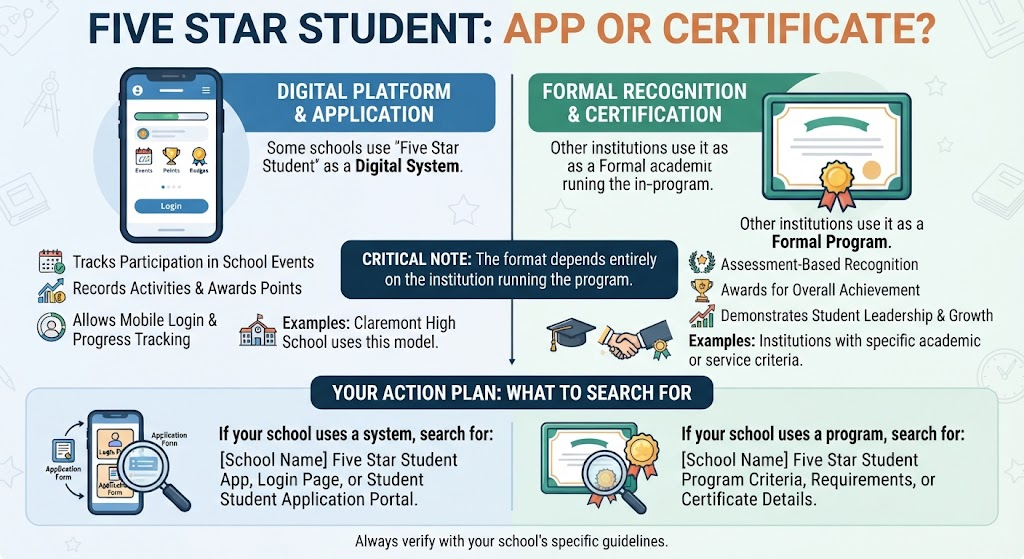
Is Five Star Student an App or a Certificate?
It can be either a program, platform, recognition system, or certificate depending on the institution.
Some schools use the Five Star Student name for a digital system that records activities and awards points. Other institutions use “Five-Star Student” as a formal recognition or assessment program.
For example, a Claremont High School planning document described the Five Star application as a way to track participation in school events and activities.
Therefore, students should identify the organization behind the program before searching for an app, login page, application form, or certificate.
Does Five Star Student Give Rewards?
Some programs do, but rewards vary.
A school-based system may provide points that lead to student rewards, while a formal award program may provide certificates, recognition, or financial awards.
The Fresno Unified handbook, for example, describes students earning points toward rewards through activities, positive behavior, and extra effort.
The Bergen County Clerk’s Five Star Student Award is another example of a formal recognition program. Its official page states that eligible local high-school winners receive a certificate and a $1,000 check.
These examples show why students should never assume that every fivestar student program offers the same rewards.
Five Star Student Application: What Should You Prepare?
If your institution has opened applications, prepare your information before submitting the form.
Application checklist
- Confirm that you meet the eligibility rules.
- Read every assessment category.
- Record your academic achievements.
- List meaningful extracurricular activities.
- Add volunteer or community work.
- Collect certificates and supporting documents.
- Ask for recommendation letters early if required.
- Check the deadline.
- Review the application before submission.
- Save a copy of everything you submit.
A well-organized application makes it easier for the evaluation committee to understand your achievements.
How Should Students Prepare for Evaluation?
Preparation should start months before the deadline.
Instead of collecting random activities simply to fill a form, focus on meaningful achievements that show learning, responsibility, and personal development.
A simple monthly tracker can help:
| Month | Academic Goal | Activity | Skill Developed | Community Work |
| January | Improve mathematics | Science club | Teamwork | — |
| February | Complete project | Debate event | Speaking | Food drive |
| March | Improve grades | Online course | Digital skills | — |
| April | Finish research | Student event | Presentation | Volunteer work |
This approach also helps students remember what they achieved when applications open.
Common Mistakes Students Should Avoid
Students can lose opportunities by overlooking simple requirements.
Mistake 1: Focusing only on grades
Good marks matter, but some programs assess several areas.
Mistake 2: Joining activities without purpose
Ten random activities may tell less about a student than two meaningful projects with clear results.
Mistake 3: Losing certificates
Keep digital and physical copies of important documents.
Mistake 4: Missing deadlines
A strong application submitted late may not be considered.
Mistake 5: Using unofficial information
Program rules can change from one institution to another. Always check the official school or university announcement.
Why Is the Five Star Student Model Useful?
A multi-area student model can encourage balanced development.
Students still need academic knowledge, but they also benefit from communication, teamwork, digital literacy, practical experience, and community involvement. The University of Blida 1 specifically describes its model as a way to combine academic excellence, professional competence, and social responsibility.
For students, the biggest practical lesson is simple: build a record that shows what you can learn, what you can do, and how you contribute.
Frequently Asked Questions
A fivestar student generally means a student recognized for strong achievement across several areas, such as academics, skills, participation, leadership, or communityx service. The exact definition depends on the institution.
No. Different schools and universities use the name for different programs. Some track activities and rewards, while others formally evaluate five areas of student development.
Check your school’s or university’s official announcement for eligibility, application dates, required documents, and assessment criteria. Do not rely on a generic application process because requirements differ between institutions.
Not necessarily. Some programs consider academic performance alongside activities, practical skills, community service, participation, or positive behavior.
Some programs provide certificates or formal recoxzgnition, but this is not universal. The award depends on the organization running the program.
Focus on consistent academic work, meaningful activities, useful skills, community participation, and good record keeping. Most importantly, follow the exact criteria published by your institution.
Conclusion
The idea behind a fivestar student is broader than getting good marks. Depending on the program, it can recognize academic achievement, practical experience, additional skills, campus involvement, online learning, leadership, and community service.
If your school or university offers a Five Star Student program, start by reading its official criteria. Then build your academic and extracurricular record around those requirements, keep evidence of your achievements, and submit your application before the stated deadline.