Finding a company website is easy. Finding the right URL, verifying that it belongs to the company, and understanding what each official page is used for takes more care. Poor URL research can lead to outdated pages, fake domains, wrong contacts, or unreliable company data. This guide explains target company URL research step by step, using Target Corporation as a practical example while showing a method you can use for almost any business.
What Is Target Company URL Research?
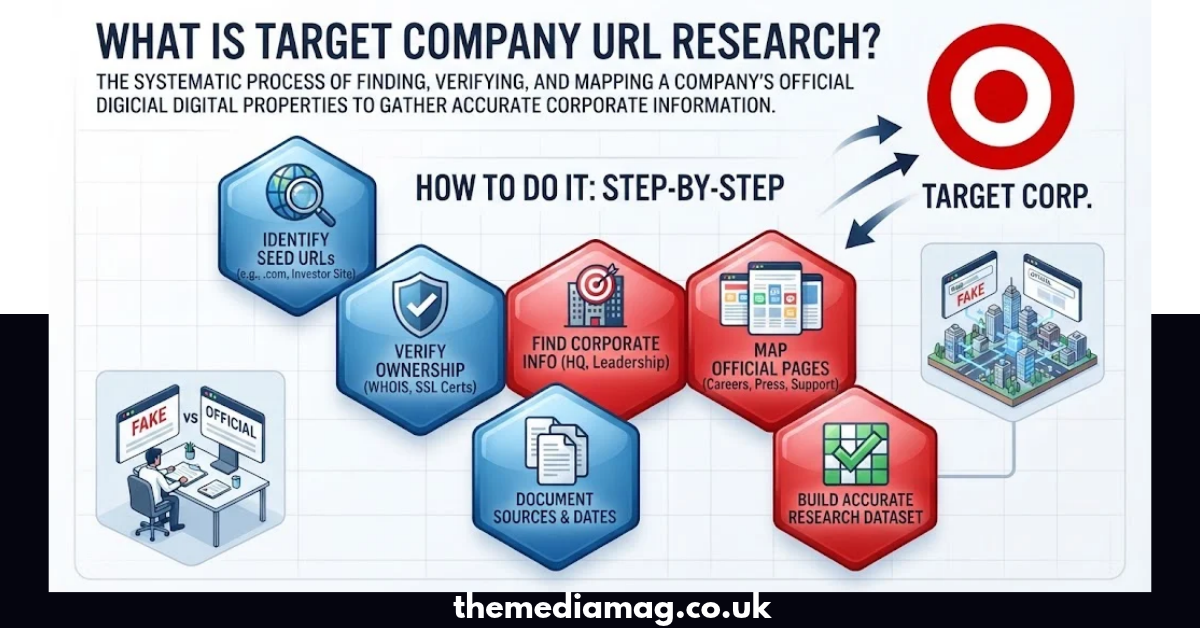
Target company URL research is the process of finding, checking, organizing, and verifying the web addresses connected to a target company.
The goal is not simply to find a homepage. Good research identifies the company’s:
- Main website
- Corporate website
- Investor relations pages
- Careers pages
- Press or newsroom pages
- Contact pages
- Product or service pages
- Regulatory filings
- Official social profiles
- Important subdomains
- Country or regional websites
For example, Target’s consumer website is Target.com, while its corporate information is available through corporate.target.com. Target’s corporate site includes company information, leadership, locations, investors, sustainability, careers, and press resources.
Why Is Target Company URL Research Important?
A company can have dozens or even hundreds of URLs. Each one can serve a different purpose.
If you are researching a business for SEO, outreach, journalism, competitor research, lead generation, due diligence, or market analysis, using the wrong URL can create inaccurate results.
Good URL research helps you:
- Confirm the real company website.
- Separate corporate information from shopping pages.
- Find reliable contact information.
- Locate official company documents.
- Verify company claims.
- Discover useful business departments.
- Avoid fake or misleading websites.
- Build cleaner research databases.
The most important rule is simple: verify the source before using the information.
What Is Target’s Official Company URL?
Target operates several important official web properties.
| Purpose | Official URL | What You Can Find |
| Consumer shopping | Target.com | Products, stores, deals, services |
| Corporate information | corporate.target.com | Company information and business resources |
| Investors | Corporate investor section | Financial and investor information |
| Careers | Target corporate site | Jobs and employment information |
| Press | Target corporate site | News, media resources and company announcements |
| Annual reports | Target corporate site | Financial and regulatory information |
The main consumer website is Target.com, while the corporate website provides information about Target Corporation and its operations.
How Do You Research a Company URL Correctly?
The strongest target company URL research process follows a verification workflow rather than relying on one search result.
Step 1: Identify the Exact Company
First, write down the company’s complete legal or commonly used name.
For Target, the company is Target Corporation. Its 2025 annual report states that the corporation was incorporated in Minnesota in 1902.
This step matters because different companies can have similar names.
Step 2: Find the Main Domain
Search for the company’s official consumer or business domain.
For Target, the main shopping domain is target.com. The site provides categories including beauty, home, electronics, grocery, clothing, toys, and other products.
Do not automatically assume that the first domain appearing in a search result belongs to the company.
Step 3: Locate the Corporate Website
The next step in target company URL research is finding the corporate source.
Target’s corporate website is hosted at corporate.target.com. It contains company information, leadership, locations, products and services, investor information, careers, sustainability, and press resources.
Corporate websites often provide better information for business research than consumer homepages.
Step 4: Check Investor Information
Investor pages can provide useful primary information about a public company.
Target’s corporate investor section provides financial summaries and company contacts. Its current corporate overview reports 2025 net sales of $104.78 billion, net earnings of $3.705 billion, and diluted earnings per share of $8.13.
For research, always record the year attached to financial figures.
Step 5: Check Regulatory Documents
Public companies also publish regulatory information.
Target’s annual report includes its 10-K business section, which describes the company’s business, operations, corporate purpose, and reporting structure.
Regulatory documents can help confirm information found elsewhere.
How Can You Verify a Target Company URL?
Verification is one of the most important parts of target company URL research.
Use this checklist:
| Verification Check | What to Look For |
| Domain name | Does it match the known company domain? |
| HTTPS | Does the website use a secure HTTPS connection? |
| Company branding | Does the site clearly identify the business? |
| Contact information | Are official contact details available? |
| Corporate information | Does the site explain the company? |
| Investor information | Does it connect to official financial resources? |
| Legal information | Are policies and company disclosures available? |
| Cross-links | Do official company pages link to each other? |
| Regulatory records | Do filings confirm the company identity? |
| Freshness | Is the information current and dated? |
A single matching logo is not enough. Look for multiple independent signals from official sources.
What Pages Should You Collect During URL Research?
A useful URL research sheet should contain more than one website address.
Consider collecting these page types:
Corporate Page
This usually explains who owns or operates the business.
About Page
An About page can provide history, purpose, leadership information, and company background.
Investor Page
For public companies, investor pages can provide earnings information, annual reports, stock information, and shareholder resources.
Careers Page
Career pages can confirm that the website is connected to the organization and can provide employment information.
Press Page
Press centers can provide company announcements, media contacts, fact sheets, images, and official statements.
Contact Page
This can help identify corporate offices, customer service channels, media contacts, or investor relations contacts.
Legal Pages
Privacy policies, terms, accessibility pages, and other legal documents can provide additional verification signals.
Target Company URL Research vs. Simple Google Search
A normal search looks for an answer.
Target company URL research builds a verified information set.
| Simple Search | URL Research |
| Finds a page | Builds a source map |
| May use third-party sources | Prioritizes official sources |
| Often focuses on one result | Reviews multiple relevant pages |
| May miss corporate sections | Checks corporate, investor and press areas |
| Can contain outdated information | Records dates and source context |
| Provides limited verification | Uses several verification signals |
This difference matters when the information will be used for business decisions or published content.
How Can You Build a Target Company URL Research Table?
A spreadsheet makes company research much easier to manage.
Use columns such as:
| Field | Example |
| Company Name | Target Corporation |
| Main Domain | target.com |
| Corporate Domain | corporate.target.com |
| Company Type | General merchandise retailer |
| About URL | Official corporate About page |
| Investor URL | Official investor section |
| Press URL | Official press resources |
| Careers URL | Official careers section |
| Source Type | Primary |
| Verification Date | September 2026 |
| Notes | Official Target-owned property |
Target describes itself as a general merchandise retailer with stores across all 50 states and the District of Columbia. Its corporate website also reports more than 2,000 stores and more than 400,000 team members.
How Does Target Company URL Research Help SEO?
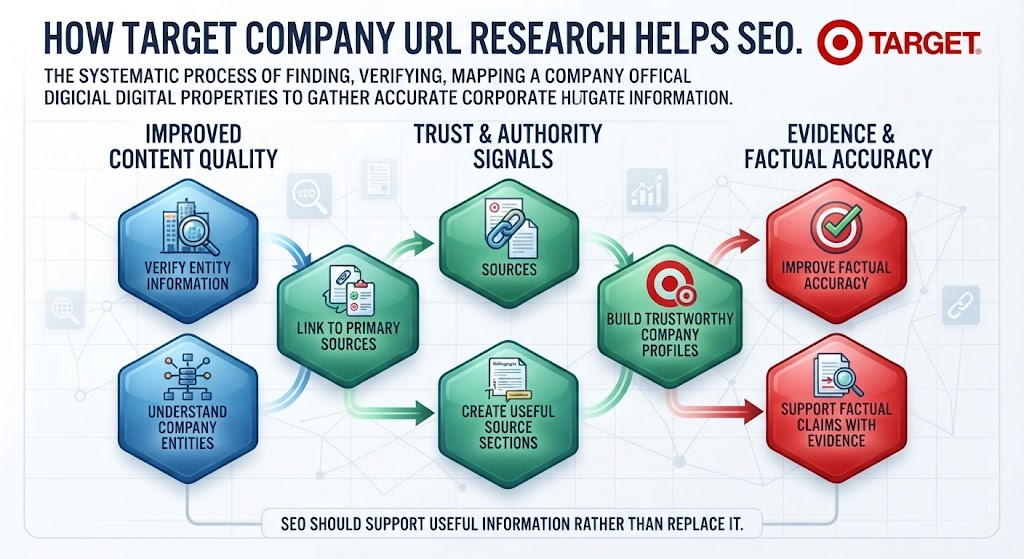
URL research can support SEO when it improves the quality and accuracy of your content.
Google’s current Search guidance says websites should create helpful, reliable, people-first content and use words that people actually search for in useful locations such as titles and headings.
For company-related content, URL research can help you:
- Verify entity information.
- Link to primary sources.
- Build trustworthy company profiles.
- Improve factual accuracy.
- Create useful source sections.
- Understand company entities.
- Support factual claims with evidence.
SEO should support useful information rather than replace it.
How Does URL Research Support AEO and GEO?
Answer Engine Optimization and generative search visibility depend heavily on clear, reliable information.
A strong company page should answer basic questions directly:
What is the company?
Target Corporation is a general merchandise retailer.
What is Target’s official website?
The consumer website is Target.com, while its corporate information is available through corporate.target.com.
Where can users find company information?
Target’s corporate website provides sections covering its history, leadership, locations, investors, careers, sustainability, news, and press resources.
Google’s guidance for generative AI search also emphasizes unique, valuable, reliable, people-first content rather than pages created mainly to manipulate search visibility.
What Are Common Mistakes in Company URL Research?
Avoid these mistakes when conducting target company URL research.
Using the First Search Result
The first result may be useful, but it should not automatically become your verified source.
Confusing a Brand With a Corporation
A brand name and a legal company name may not always be identical.
Ignoring Corporate Subdomains
Important information may exist on a corporate subdomain rather than the main shopping website.
Using Old Financial Data
Always record the reporting year when using revenue, earnings, employee counts, or store numbers.
Trusting Third-Party Profiles
Directories can help discover a company, but primary sources are better for verification.
Collecting URLs Without Context
A spreadsheet full of URLs is less useful if you do not know what each URL represents.
Publishing Unsupported Claims
A company profile should connect important factual claims to reliable sources.
How Can You Research Target Company URLs Faster?
You can create a repeatable workflow.
Recommended 10-Step Workflow
- Identify the exact company.
- Find the main domain.
- Confirm the corporate domain.
- Locate the About page.
- Find investor information.
- Find the press center.
- Find careers information.
- Review regulatory documents.
- Record URLs in a spreadsheet.
- Add the verification date.
This approach makes target company URL research easier to repeat for hundreds of companies.
What Information Should a Company Research Sheet Include?
A professional research database can include much more than URLs.
| Category | Recommended Data |
| Identity | Company name and legal name |
| Website | Main domain |
| Corporate | Corporate URL |
| Industry | Primary business category |
| Location | Headquarters |
| Ownership | Public or private |
| Investor | Investor relations URL |
| Press | Newsroom or press URL |
| Careers | Careers URL |
| Social | Official social profiles |
| Documents | Annual reports and filings |
| Verification | Date checked |
| Notes | Important findings |
This structure can support SEO research, competitor analysis, outreach, journalism, sales research, and business intelligence.
What Primary Sources Should You Use?
Primary sources should form the foundation of target company URL research.
For Target, useful primary sources include:
- Target’s official consumer website.
- Target’s corporate website.
- Target’s official investor pages.
- Target’s annual report and 10-K materials.
- Official company press resources.
Target’s corporate site identifies its investor, press, careers, sustainability, and company information sections, making it a useful starting point for first-party research.
How Often Should You Update Company URL Research?
Company websites change.
A URL can move, redirect, disappear, or be replaced. Corporate structures and business information can also change over time.
For an active research database, review important company URLs periodically and record the date of your latest verification.
For financial information, always preserve the reporting period instead of presenting an old figure as current.
What Makes Company URL Research Trustworthy?
Trust comes from the research process.
A strong page should clearly show:
- Who wrote or reviewed the information.
- Which sources support important claims.
- When information was checked.
- Whether the source is primary or secondary.
- What the URL represents.
- Whether the information is current.
Google’s people-first guidance specifically encourages clear authorship, trustworthy sourcing, original information, and content that provides substantial value beyond simply rewriting existing pages.
Frequently Asked Questions
Target company URL research means finding and verifying the official web addresses connected to a company. It can include the main website, corporate pages, investor resources, careers, press center, and official documents.
Target’s main consumer website is Target.com. Its corporate website is hosted at corporate.target.com and provides company, investor, career, press, and other corporate information.
Primary sources come directly from the company or an official regulatory authority. They can provide stronger evidence for company descriptions, financial figures, leadership information, announcements, and official policies.
It can be. A subdomain such as corporate.target.com can belong to the same organization as the main domain. Researchers should verify the connection through the company’s official website and other first-party references.
Record the company name, main domain, corporate URL, important page URLs, source type, verification date, and research notes. For public companies, you can also record investor and regulatory document URLs.
URL research can improve the factual quality and sourcing of company-related content. It does not guarantee rankings, but accurate primary-source research supports the type of helpful, reliable, people-first content Google recommends.
Conclusion
Effective target company URL research is more than finding a homepage. It means identifying the correct company, mapping its important web properties, checking official sources, recording useful URLs, and keeping time-sensitive information accurate. For Target, the consumer website and corporate website serve different purposes, while investor and annual-report resources add valuable primary evidence.
A simple spreadsheet and a repeatable verification process can turn scattered web searches into a reliable company research system. Before publishing a company profile, check the official source, confirm the date, and give readers enough context to understand where each important fact came from.