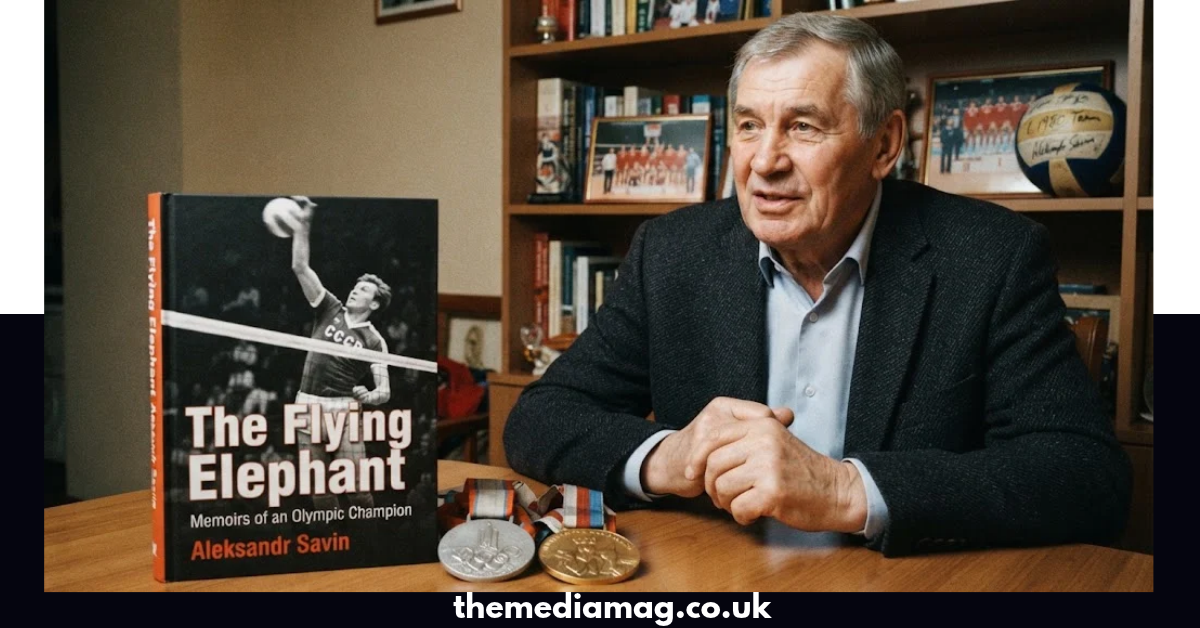
Winning an Olympic medal can look simple from the outside: train, compete, win. But an athlete’s real story includes years of practice, teammates, coaches, setbacks, travel, and pressure. The Flying Elephant: Memoirs of an Olympic Champion Alexander Savin gives readers a closer look at the sporting life of Soviet volleyball player Aleksandr Savin. He won Olympic silver in 1976 and gold in 1980, making his career a useful window into elite volleyball and a major period in Olympic sport.
What Is The Flying Elephant Memoirs of an Olympic Champion Alexander Savin?
The Flying Elephant: Memoirs of an Olympic Champion is a sports memoir centered on Aleksandr Borisovich Savin, the Soviet volleyball player who competed at the 1976 Montreal and 1980 Moscow Olympics.
The book presents Savin’s sporting life through personal memories rather than simply listing tournament results. The English edition was created through a family-led translation project involving Savin’s half-brother Andrei Savine and other collaborators.
For readers searching for the flying elephant memoirs of an olympic champion alexander savin, the key point is that this is connected to a real Olympic volleyball career, not a fictional sports story.
Who Was Alexander Savin?
Aleksandr Savin was born on July 1, 1957, in Taganrog, Russia. Olympedia records him at 200 cm tall and lists CSKA Moskva among his affiliations.
He became an important member of the Soviet men’s volleyball team during the late 1970s and early 1980s. The International Volleyball Hall of Fame inducted Savin in 2010 in its Male Indoor Player category.
His Olympic record is especially clear:
| Olympic Games | Team | Result |
| Montreal 1976 | Soviet Union | Silver |
| Moscow 1980 | Soviet Union | Gold |
| Total | Soviet Union | 2 medals |
Olympedia records one Olympic gold and one Olympic silver for Savin.
Why Is The Flying Elephant Memoir Interesting?
The appeal of the flying elephant memoirs of an olympic champion alexander savin comes from the gap between a medal table and an athlete’s lived experience.
An Olympic result tells readers where a team finished. A memoir can preserve the memories surrounding the result: people, preparation, competition, travel, relationships, and moments that official statistics cannot capture.
The English translation also gives international readers access to Savin’s story without requiring them to read the original Russian material.
What Happened at the 1976 Montreal Olympics?
The 1976 Montreal Games were an important part of Savin’s Olympic story.
The Soviet men’s team reached the gold-medal match after defeating Cuba in the semifinal. Poland then defeated the Soviet Union 3–2 in the final, leaving Savin and his teammates with silver. The International Volleyball Hall of Fame records that Savin played in all five matches at Montreal.
That result became an important part of the road toward the next Olympic Games.
Savin’s 1976 Olympic Result
- Event: Men’s volleyball
- Host city: Montreal
- Team: Soviet Union
- Final result: Silver medal
- Final opponent: Poland
- Final score: Poland won 3–2
- Savin’s participation: All five Soviet matches
The silver medal also shows why Savin’s Olympic story cannot be reduced to one victory. His career included both a major Olympic defeat and a later Olympic championship.
How Did Alexander Savin Win Olympic Gold in 1980?
The 1980 Moscow Olympics brought a different result.
The Soviet team began its campaign with a 3–1 victory over Czechoslovakia. It then moved through pool play against Italy, Bulgaria, and Cuba before defeating Romania in the semifinal.
In the gold-medal match, the Soviet Union defeated Bulgaria 3–1. Savin played in all six matches, according to the International Volleyball Hall of Fame.
Olympedia also records Savin as a member of the Soviet team that won gold in men’s volleyball at Moscow 1980.
From Silver to Gold
| Year | Olympic Games | Savin’s result |
| 1976 | Montreal | Silver |
| 1980 | Moscow | Gold |
This four-year gap is one of the clearest ways to understand Savin’s Olympic career. His record shows both the disappointment of losing an Olympic final and the achievement of eventually winning one.
What Does The Memoir Tell Readers About Soviet Volleyball?
The Flying Elephant memoirs of an Olympic champion Alexander Savin are closely connected to the Soviet volleyball environment in which Savin developed.
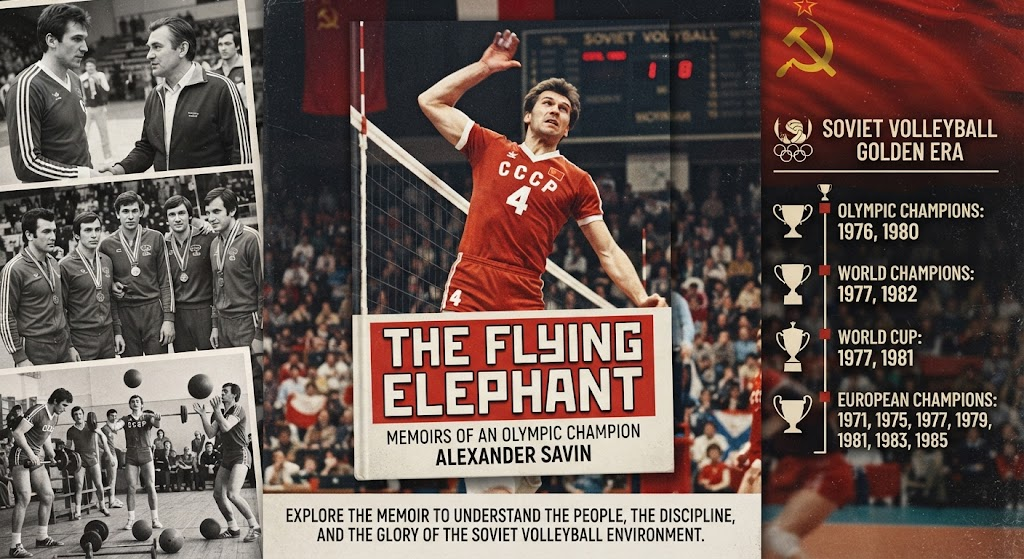
His career included CSKA Moscow and the Soviet national team. During this period, Soviet volleyball competed successfully across major international tournaments, including the Olympic Games, World Championships, World Cup, and European Championships.
The memoir therefore has value beyond Savin’s personal biography. It can also help readers understand the people and sporting environment surrounding an important generation of Soviet volleyball.
What Is the Story Behind the English Translation?
The English edition has an unusual personal history.
Andrei Savine has described translating the memoir as a project that took more than a year. He explained that Alexander Savin was his half-brother and that the translation project became a way of reconnecting with him and learning about the people mentioned in the memoir.
Andrei worked on the project with Alfredo Cabero and Ioulia Soudakova. His account says the finished English book became his contribution to preserving the history surrounding Savin, his teammates, coaches, and friends.
This background adds an important layer to the English edition. It was not simply a title being converted from one language to another; it involved a personal effort to make Savin’s sporting memories accessible to English-speaking readers.
What Are The Flying Elephant Book Details?
Current published information identifies the English edition as a Kindle book. Public information connected with the translation project identifies Amazon product identifier B0FXVDWW16 and a listed publication date of October 26, 2025.
| Book Detail | Information |
| Full title | The Flying Elephant: Memoirs of an Olympic Champion |
| Author | Alexander Savin |
| Sport | Volleyball |
| Format | Kindle edition |
| Language | English |
| Reported publication date | October 26, 2025 |
| Reported length | 514 pages |
| Reported photographs | 240+ |
| Amazon identifier | B0FXVDWW16 |
| Olympic career | 1976 and 1980 |
| Olympic medals | Silver and gold |
The reported page count and photograph count come from current published edition information rather than from Olympedia or the Volleyball Hall of Fame.
Readers should check their local Amazon marketplace for the current price, availability, and Kindle features because digital-book details can vary by region and change over time.
Does The Book Include Historical Photographs?
Yes. Published information about the English edition describes it as containing more than 240 photographs. Andrei Savine also mentioned rare archival photographs when discussing the completed English translation.
The photographs are useful because sports history is not only about scores. Images can preserve uniforms, athletes, venues, ceremonies, teams, and the visual character of an earlier sporting era.
For readers interested in Soviet volleyball history, the visual material can therefore complement the personal narrative.
Why Does The 1976–1980 Journey Matter?
Savin’s two Olympic appearances create a simple but meaningful timeline.
1976: Soviet Union wins silver in Montreal.
1980: Soviet Union wins gold in Moscow.
The International Volleyball Hall of Fame records Savin’s participation in both Olympic campaigns and notes that he played every match for the Soviet team at both Games.
That record gives the memoir a strong historical framework. Readers can follow an athlete who experienced Olympic disappointment and later returned to win the highest medal.
What Other Achievements Are Connected to Savin’s Career?
Savin’s career extended beyond the Olympics.
The International Volleyball Hall of Fame records Soviet European Championship victories in 1977 and 1979 during his career, along with the Soviet team’s 1977 World Cup and 1978 World Championship victories.
This broader record matters when reading the flying elephant memoirs of an olympic champion alexander savin because the Olympics were only part of his international career.
Major Career Context
- Olympic silver — Montreal 1976
- Olympic gold — Moscow 1980
- European Championship titles — 1977 and 1979
- World Cup title — 1977
- World Championship title — 1978
- International Volleyball Hall of Fame — 2010
Who Should Read The Flying Elephant?
The memoir can appeal to several types of readers.
Volleyball Fans
Volleyball followers can use the book to explore a major Soviet-era player beyond match statistics.
Olympic History Readers
Anyone interested in the 1976 and 1980 Olympic volleyball tournaments can place Savin’s memories alongside official competition records.
Athletes and Coaches
The memoir’s value lies partly in its first-person perspective on elite sport, making it relevant to people interested in athletic careers and team environments.
Sports Historians
The combination of personal memories, international competition, and archival photographs can provide useful historical context.
Readers Interested in Soviet Sports
Savin’s career developed during a major period of Soviet international sport, giving the book a connection to a wider sporting history.
How Can Readers Find The Correct Alexander Savin Book?
Search results can produce different works with similar names, so readers should verify the details before purchasing.
Use this checklist:
- Look for the full title The Flying Elephant: Memoirs of an Olympic Champion.
- Confirm that Alexander Savin is listed as the author.
- Check that the subject is volleyball.
- Look for the English Kindle edition if you want the translated version.
- Check the Amazon identifier B0FXVDWW16 where applicable.
- Review the current Kindle sample before buying.
- Confirm the current price and regional availability on your Amazon marketplace.
This simple check can help separate the memoir from unrelated books or pages using the phrase “Flying Elephant.”
What Makes The Memoir Different From A Normal Sports Biography?
A conventional sports biography may depend heavily on statistics, career summaries, interviews, and historical records.
A memoir has another source of value: the athlete’s own recollections.
That distinction matters for the flying elephant memoirs of an olympic champion alexander savin. Official records can establish that Savin won Olympic silver and gold, while the memoir project is intended to preserve the personal memories connected to those years.
The two approaches work well together. Records establish what happened; personal recollections can add context around the people and experiences behind those results.
The Flying Elephant Memoirs: Quick Facts
| Question | Short Answer |
| Who wrote the memoir? | Alexander Savin |
| What sport did he play? | Volleyball |
| What country did he represent? | Soviet Union |
| What position was he associated with? | Middle blocker |
| What did he win in 1976? | Olympic silver |
| What did he win in 1980? | Olympic gold |
| Was he a Hall of Fame inductee? | Yes, in 2010 |
| Is an English edition available? | Yes, as a Kindle edition |
| Reported Kindle length | 514 pages |
| Reported photographs | More than 240 |
| Reported Amazon identifier | B0FXVDWW16 |
The Olympic and Hall of Fame information comes from Olympedia and the International Volleyball Hall of Fame, while the English-edition details are based on information connected to the translation project.
FAQs
Alexander Savin is the author of the memoir. The English edition involved his half-brother Andrei Savine, along with other translators and editors.
It is a memoir connected to Alexander Savin’s life and career in elite Soviet volleyball, including his Olympic experiences and the sporting world around him.
Yes. Savin won Olympic gold with the Soviet men’s volleyball team at the 1980 Moscow Games. He had previously won silver at Montreal 1976.
Yes. The English edition was produced through a translation project involving Andrei Savine and other collaborators and was released in Kindle format.
Current published information lists the Kindle edition at approximately 514 pages. Digital page counts can vary by device and reading settings, so this should be treated as the listed edition length rather than a fixed physical-page count.
Yes. The International Volleyball Hall of Fame lists Aleksandr Savin as a 2010 inductee in the Male Indoor Player category.
Conclusion:
The Flying Elephant: Memoirs of an Olympic Champion Alexander Savin connects a personal sports story with a documented chapter of Olympic volleyball history. Savin’s Olympic record includes silver at Montreal 1976 and gold at Moscow 1980, while his wider career includes major international achievements and recognition from the International Volleyball Hall of Fame.
The English translation adds another reason to explore the book. Through the work of Andrei Savine and his collaborators, Savin’s memories became available to a wider English-speaking audience.